
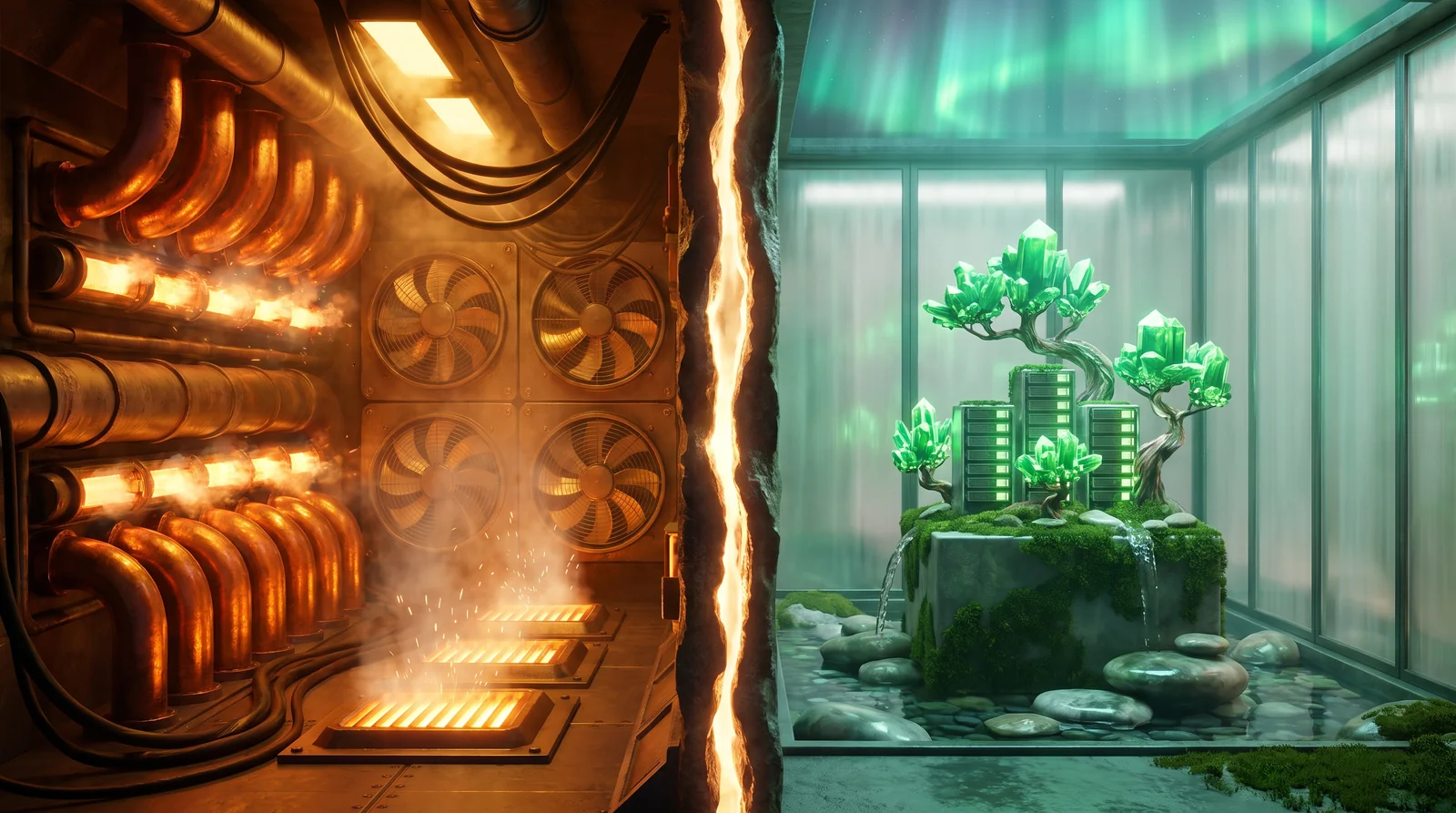
Staking for most people. Mining if you have cheap electricity.
Staking starts with $50 and earns 3% to 15% APY with no hardware. Mining needs $2,000 plus in rigs and cheap power to break even. Both work, but staking is the practical choice for anyone without access to industrial electricity rates. The crossover point where mining beats staking depends entirely on your electricity rate and the size of your initial investment.
Head to head
Click a contender to see the full breakdown.
Crypto Staking
Lock coins, earn rewards, no hardware needed
- Start with as little as $50 on most exchanges
- No hardware, no electricity bill, no fan noise
- 3% to 15% APY depending on the blockchain
- One-click staking on major exchanges
- Liquid staking options let you earn while keeping access to funds
- Rewards are lower than mining at scale in peak bull cycles
- Coins are locked during the unbonding period (7 to 30 days)
- Returns vary monthly based on network participation
- Fully exposed to the coin's price, a 30% crash wipes out years of rewards
Feature comparison
Every metric, side by side. Green = winner for that row.
| Feature | Crypto Staking | Crypto Mining |
|---|---|---|
| Startup cost | $50 | $2,000+ |
| Hardware required | None | GPU or ASIC rig |
| Ongoing costs | None | Electricity + cooling |
| Typical APY | 3% to 15% | 5% to 20% before depreciation |
| Technical skill | None | Moderate |
| Coin liquidity | 3 to 30 day unbonding | Sell hardware anytime |
| Noise level | None | 75 dB+ |
| Tax complexity | Simple | Complex |
How staking works
Staking is locking up your coins to help secure a proof-of-stake blockchain. In return, the network pays you rewards. Think of it like a high-interest savings account, except your money is in crypto and the rate changes monthly.
You do not need special hardware. Just a wallet, some coins, and a platform to stake through. Most major exchanges offer one-click staking. You buy the coin, hit stake, and rewards land in your wallet every day or week.
Typical annual returns range from 3% to 15% depending on the blockchain. Ethereum staking pays around 3.3% to 4.5% APY. Solana offers 6% to 8%. Some smaller chains push 12% to 15%, though those carry more risk.
You can start with $50 on most exchanges. Pick a coin with staking support and start earning within minutes. No electricity bill, no fan noise, no GPU shopping. The appeal is obvious and the barrier to entry is essentially zero.
The worst case with staking: your coins are locked during an unbonding period of 3 to 30 days, depending on the blockchain. If the price spikes during that time, you cannot sell. But you also do not lose coins.
How mining works
Mining uses computer hardware to solve cryptographic puzzles that validate transactions on proof-of-work blockchains like Bitcoin. The miner who solves the puzzle gets the block reward plus transaction fees.
Mining requires specialized hardware. GPU rigs cost $3,000 to $5,000 to build. ASIC miners for Bitcoin cost $2,000 to $15,000 per unit. You also need cooling, ventilation, and a place where the noise will not drive you crazy.
The financial math is brutal. A single Antminer S19 Pro draws 3,250 watts. At $0.12 per kWh, that costs about $280 a month in electricity alone. That same machine earns roughly $300 to $400 a month at current prices. Your profit margin sits somewhere between thin and imaginary.
Electricity is the biggest variable. At $0.10 per kWh, mining breaks even slowly. At $0.05 per kWh, it becomes profitable faster. Most home miners in the US pay $0.12 to $0.15 per kWh, which makes it hard to compete with industrial operations.
Altcoin mining using GPUs is more accessible but less profitable than it was in 2021. A mid-range GPU rig costs $3,000 to $5,000 and earns maybe $150 to $250 a month before electricity. The golden era of GPU mining ended with Ethereum's switch to proof-of-stake.
Which actually earns more
For under $1,000 invested, staking wins every time. A $500 stake in Solana at 7% APY returns $35 per year with zero ongoing costs. A $500 mining setup does not exist. You cannot buy a meaningful mining rig for $500.
At $5,000 or more, mining can pull ahead. A $5,000 ASIC miner at $0.06 per kWh electricity might return $800 to $1,200 per year. The same $5,000 staked at 7% returns $350. But the miner needs maintenance, cooling, and the hardware depreciates.
The crossover point where mining beats staking depends entirely on your electricity rate. At $0.05 per kWh, mining wins at scale. At $0.12 per kWh or higher, staking wins at every investment level.
For secure storage of staked or mined coins, a hardware wallet protects your earnings from exchange hacks. Never leave your long-term stack on an exchange.
Which makes more sense for beginners
For someone just starting, staking wins by a wide margin. You can begin with $50 on an exchange, choose a coin that supports staking, and earn rewards within your first hour. There is no learning curve beyond understanding that your coins are locked for a period.
Mining as a beginner is a trap if you do not understand the full cost picture. The hardware resale market is full of used ASICs sold by miners who upgraded. You might buy a machine that was profitable a year ago but now earns less than the electricity it consumes. That is called mining at a loss, and it happens more often than newcomers expect.
If you already own a gaming PC with a strong GPU, you can try mining an altcoin like Monero on the side. Set it up, let it run, and see what happens. But even then, the noise and heat make it a hard sell for a home office. Staking asks none of that from you.
Risks you need to know for both methods
Staking risks are mostly about the coin itself. If the coin drops 50% in price, your 8% staking reward does not save you. You lost 42% in real terms. There is also slashing risk on some blockchains, where the protocol penalizes your stake if the validator you delegated to goes offline or misbehaves.
Always check the slashing history of any validator before you delegate your coins. A validator with a history of downtime can cost you a portion of your stake. This is rare on major chains like Ethereum and Solana, but it exists on smaller networks.
Mining risks are about hardware, electricity, and Bitcoin's price all moving against you at once. If Bitcoin drops, mining becomes unprofitable fast because your electricity bill stays the same but your coin earnings are worth less. ASICs also depreciate quickly. A machine that costs $8,000 today might be worth $2,000 in two years.
The biggest risk for both methods: you are still in crypto. None of this matters if the market crashes 80% and stays there for years. Treat every staking reward and every mined coin as a long-term bet on the asset, not as steady income.
Which one is right for you?
Click whichever line sounds like you. We'll show our pick.
Staking for 90% of people. Mining only with cheap electricity.
Staking starts at $50 with no hardware and earns 3% to 15% APY. Mining needs $2,000 plus in rigs and sub-$0.06 per kWh electricity to compete.
For passive income without the noise and maintenance, staking is the clear winner. If you want a hobby that might pay for itself, mining with a single GPU is worth exploring.
For secure storage of your earnings, keep them on a hardware wallet.
Frequently asked questions
Staking is safer for your wallet in the short term. You do not spend thousands on hardware that can become obsolete. But both carry crypto market risk. If prices crash hard, stakers lose portfolio value and miners lose their operating margin.
Yes, and many people do. Stake Ethereum or Solana for steady passive income while running a small GPU mining operation on the side. Just be clear about your total exposure to crypto. Doubling down on one asset class amplifies both gains and losses.
At 6% APY, about $60 per year or $5 per month. At 12% APY on a higher risk chain, about $120 per year. Not life-changing, but it covers exchange fees and compounds over time. The real value of staking is the compounding effect across multiple years.
At most residential electricity rates, no. A mid-range GPU rig at $0.12 per kWh might earn $150 to $250 per month before electricity, which can eat 50% or more. The golden era of GPU mining ended with Ethereum's switch to proof-of-stake.
You initiate an unbonding request through your wallet or exchange. Your coins are released after a waiting period. Ethereum takes about 7 days. Solana about 3 days. During that time you stop earning rewards, but you do not lose any coins.